How I Earned $817 on SproutGigs in 6 Months: My Strategy, Results & Lessons
 By jonbiss
•
•
24 minutes read
By jonbiss
•
•
24 minutes read

A real freelancer’s step-by-step playbook for earning on SproutGigs (formerly Picoworkers) — with payment proof, satisfaction rate tactics, and the routine I use to clear $3 to $5 per task.
Published on Long Money · Last updated: 2026 · SproutGigs strategy guide
Six months ago, I opened my SproutGigs dashboard on a Tuesday morning and saw something I did not expect: $817.39 in lifetime earnings, with another $397.07 pending in the queue. That number was not a lottery win or a one-off lucky week — it was the slow, unglamorous result of completing 807 microtasks over six months, 803 of which were rated Satisfied by buyers. If you have ever stared at one of those SproutGigs landing pages wondering whether the platform is real or just another scam dressed up in green branding, this article is for you. I am going to walk you through exactly what I did, what I would do differently if I were starting today, and the specific strategies that took me from $0.05 sign-up tasks to $4.55 Power Jobs that pay ten times that. Nothing here is theory — every number, every tactic, every screenshot comes from my own account.
Before we go any further, let me be honest about what SproutGigs is and what it is not. It is not a get-rich-quick scheme, it is not a replacement for a full-time job, and it is definitely not a place where you can show up once a week and expect money to fall out of the sky. What it is, when you treat it like a real side hustle with a real system, is one of the most accessible micro-task platforms on the internet. You can start with zero experience and still earn your first dollar within an hour of signing up. The catch is that entry-level work pays almost nothing — three cents to watch a YouTube video, five cents to sign up for a newsletter. Most people quit in that phase. I almost did too. The strategy that got me to $817 was not about working harder; it was about surviving the early grind long enough to unlock the higher-paying work the platform hides behind its level system.
This guide covers what SproutGigs actually is, how the freelancer level system works, the seven specific tactics I used to push my satisfaction rate to 99.5 percent, the mistakes that quietly tank your account, and the realistic income you can expect over your first six months. By the end, you will have the same playbook I wish someone had handed me on day one.
What SproutGigs Actually Is (And Why Nobody Talks About It Properly)
SproutGigs is a micro-task marketplace that connects buyers — small businesses, app developers, content creators, and affiliate marketers — with freelancers willing to perform short online tasks for small payments. The platform was originally launched as Picoworkers in 2014, and built a reputation as one of the more reliable places on the internet for low-barrier freelance work. In early 2022, the team rebranded to SproutGigs, expanded the job categories, added a more polished interface, and introduced the freelancer level system that now sits at the center of how the platform distributes higher-paying work. The rebrand was not just cosmetic — it represented a real shift toward rewarding quality over volume, which is exactly what makes the platform worth taking seriously today.
The platform operates on a two-sided model. Buyers post tasks they need completed: signing up for their website, installing their app, watching their promotional video, leaving a review, following their social media account, completing a survey, or writing a short piece of content. Freelancers browse those tasks, claim the ones they want, complete them, submit proof, and get paid once the buyer approves the work. Payments range from a few cents for the simplest tasks to fifteen dollars or more for complex content jobs, with the average microtask falling somewhere between ten cents and a dollar. The platform takes a cut from both sides — buyers pay a small service fee on top of the task price.
Where SproutGigs separates itself from competitors like Microworkers and RapidWorkers is in its level system. Most micro-task platforms treat all freelancers identically — you see the same job pool whether you have completed ten tasks or ten thousand. SproutGigs does not work that way. As you complete tasks and earn Satisfied ratings, you accumulate earn points that push you up through five freelancer levels, each unlocking higher-paying job tiers. A Level 1 Starter sees only the cheapest tasks; a Level 4 Pro sees Featured and Power Jobs that pay three to ten times as much. This is the single most important mechanic on the platform, and most beginners never figure it out because they quit before they reach the level where the real money becomes visible.
My SproutGigs Earnings Proof — $817 in Six Months
I want to start with the proof, because I have read too many SproutGigs reviews that talk in vague generalities about “earning potential” without ever showing a real number. Below is a screenshot straight from my own SproutGigs dashboard, taken on the MicroJobs page where I was filtering for the highest-paying jobs available to me at Level 4. The yellow banner shows my cumulative earned balance, and you can see the pending balance alongside it. I have not edited this screenshot except to crop the browser chrome.
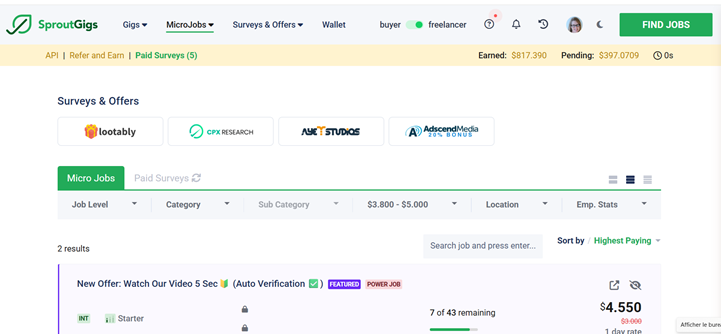
My SproutGigs dashboard — $817.39 earned, $397.07 pending, with two Featured Power Jobs visible in the $3.80 to $5.00 pay range. This is what the platform looks like once you reach Level 4.
Let me walk you through what you are looking at. The yellow banner shows $817.390 as my total earned — that is the platform’s European decimal format, translating to $817.39 USD. The pending balance of $397.0709 represents tasks I had completed but which were still awaiting buyer approval; that money typically clears within 24 to 72 hours. Below the banner, the MicroJobs interface shows the price filter set to $3.800 to $5.000, the range I now work in almost exclusively. The job listing shown — a Featured Power Job paying $4.55 for watching a five-second video with auto-verification — became available to me only after I crossed into the higher freelancer levels. Six months ago, jobs at this price point did not even appear in my feed.
That $817 is the cumulative result of about 180 hours of work spread across 26 weeks, working roughly one to two hours a day, five days a week. Some weeks I earned $15; other weeks I earned $80. The variance is enormous, and it depends almost entirely on which jobs are available, how many buyers are running campaigns, and how disciplined I was about maintaining my satisfaction rate. The first three months produced roughly $200 combined, while the last three months produced over $600 — and that acceleration is the entire point of treating SproutGigs as a long game rather than a quick cash grab.
Setting Up Your Account the Right Way (Most Beginners Skip This)
Account setup is the most boring part of any platform tutorial, which is exactly why most beginners blow through it in five minutes and then wonder why their accounts get flagged three weeks later. SproutGigs is unusually strict about account hygiene, and the security banner that periodically appears at the top of your dashboard — the yellow one nagging you to add a recovery email — is not optional housekeeping. It is the platform’s first line of defense against the fraud and multiple-account abuse that plagues every micro-task marketplace. If you skip it, you are signaling to the system that your account is low-trust, and low-trust accounts do not get access to higher-paying jobs no matter how many tasks they complete.
Here is the exact setup routine I followed. First, register with a single primary email address that you actually check. Second, immediately add a recovery email under Settings → Security. Third, complete the Identity/KYC verification step, which involves uploading a government-issued ID and a selfie holding that ID. Yes, it feels invasive, but KYC-verified accounts get access to higher-paying job tiers that unverified accounts never see. Fourth, connect a withdrawal method — I use Lightning (Tipalti) for fast payouts, but Airtm, Skrill, and PayPal are also supported. Fifth, set your freelancer profile to public so buyers can see your stats.
SproutGigs evaluates every account on a hidden trust score that incorporates profile completeness, KYC status, recovery email presence, and account age. I made the mistake of skipping KYC for my first three weeks because I was paranoid about uploading my ID to a website I had never heard of. The result was that I completed 47 tasks and still could not access any jobs paying more than 30 cents. The moment I completed KYC, the job pool visibly expanded, and within a week I was seeing $1+ tasks for the first time. Do not make my mistake.
Understanding the Freelancer Level System (The Only Mechanic That Matters)
If you take only one thing away from this article, let it be this: the freelancer level system is the single most important mechanic on SproutGigs, and every decision you make should be evaluated through the lens of how it affects your level progression. The screenshot below is from my Freelancer Stats page, and it shows the four metrics the platform uses to evaluate your account: Tasks Done, Satisfied, Not Satisfied, and Submit tasks interval. These numbers, plus the cumulative Earned total, are what the algorithm watches when deciding whether to promote you, demote you, or unlock new job tiers.
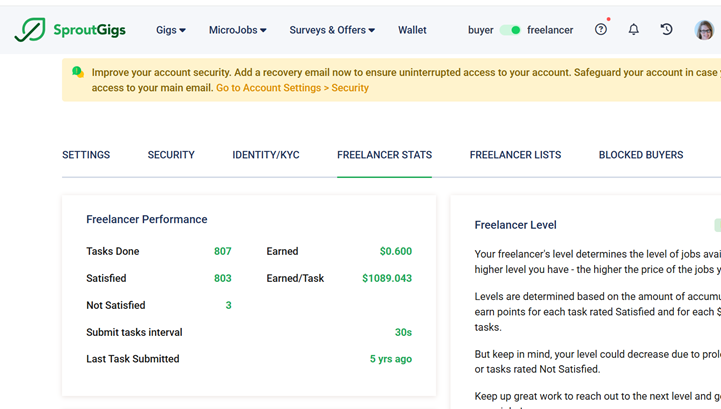
My Freelancer Stats page — 807 tasks completed with a 99.5% satisfaction rate (803 Satisfied, only 3 Not Satisfied). This is the metric that unlocked Level 4 and the $3 to $5 job tier for me.
Look at those numbers carefully. 807 tasks done. 803 rated Satisfied. Only 3 rated Not Satisfied. That works out to a 99.5 percent satisfaction rate — the number I am most proud of in this entire journey, more than the $817 or reaching Level 4. The reason is simple: the satisfaction rate is the lever that controls everything else. Above 98 percent, the platform unlocks Featured Jobs. Above 99 percent, Power Jobs start appearing in your feed. Both of those job types pay two to ten times what ordinary microtasks pay, and they are gated entirely behind your satisfaction percentage. The three tasks that got rated Not Satisfied cost me more in lost opportunity than any single task ever earned me.
The level system works on earn points, calculated based on a formula that combines total tasks completed, total dollars earned, and satisfaction rate. The exact formula is not published, but from my tracking and conversations with other freelancers, the rough thresholds are 50 points for Level 2, 200 for Level 3, 1000 for Level 4, and 5000 for Level 5. You earn points faster by completing higher-paying jobs with Satisfied ratings, and you lose points when tasks get rated Not Satisfied or when you go through prolonged inactivity. The graphic below shows what each level unlocks in terms of job access and pay range.
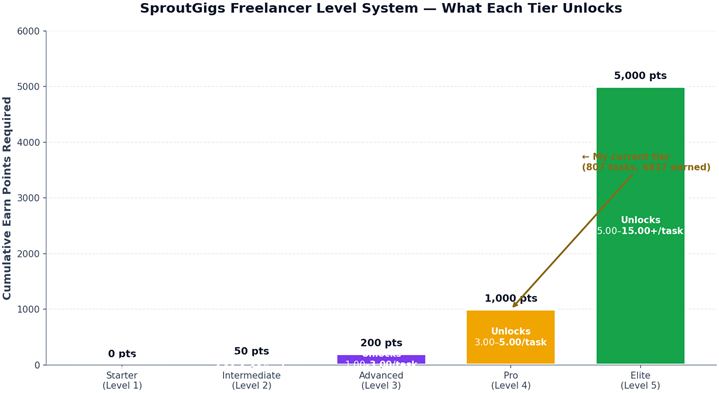
The five SproutGigs freelancer levels and the pay ranges each one unlocks. Reaching Level 4 was the single biggest inflection point in my earnings — it is where the $3 to $5 per task range becomes consistently available.
Your first month on SproutGigs is going to be the hardest, lowest-paid month you will ever have on the platform — and there is no shortcut. You have to grind through Starter tasks paying $0.05 to $0.30 each, complete them flawlessly, and let the earn points accumulate. I earned exactly $42 in my first month, which works out to less than $1.50 per hour of work. The next month was $68, then $85, then $145, then $190, and finally $287 in month six — and the acceleration was almost entirely driven by level unlocks, not by working more hours. If I had quit in month one, I would have written SproutGigs off as a scam, and I would have been wrong.
My 7-Step Strategy for Maximum Earnings on SproutGigs
Everything I have learned about SproutGigs over the past six months distills into seven specific tactics. Most of them are obvious once you understand the platform’s incentives, but I did not figure out several of them until month three or four, and the ones I figured out late cost me real money. Read all seven before your next session, because they work together as a system, not as a menu of optional tweaks.
Step 1: Treat Your Satisfaction Rate Like It Is Made of Glass
Your satisfaction rate is the most fragile, most valuable number on your account. A single Not Satisfied rating can drop your percentage by a full point when you are at 50 tasks, and it can take a week to recover. The rule I follow is absolute: if I am not 100 percent certain I can complete a task correctly, I do not claim it. I would rather earn nothing for an hour than risk a rejection that costs me access to $4 jobs for the next month. Read every instruction twice. Take the required screenshots. Submit proof exactly in the format the buyer requested.
Step 2: Climb Levels Deliberately, Not Accidentally
Most freelancers complete whatever tasks catch their eye and let their level climb as a side effect. You should pick tasks strategically based on which ones will move your earn points the fastest. Higher-paying tasks award more earn points per Satisfied rating, so even if a $1 task takes three times as long as a $0.10 task, it advances your level four to five times faster. Filter by Highest Paying, ignore everything below $0.50 unless you are desperate, and complete the higher-paying tasks even if they take longer. Your hourly rate will look terrible in the short term, but you will reach Level 2 in half the time it would otherwise take.
Step 3: Hunt Featured and Power Jobs Relentlessly
Once you hit Level 3, Featured and Power Job tags start appearing, and these are where the real money lives. Featured Jobs typically pay 1.5 to 2 times the base rate. Power Jobs are even better — curated by SproutGigs staff as high-value tasks, often with auto-verification enabled, they regularly pay $3 to $5 for tasks that would otherwise be $1 to $1.50. The trick is that Power Jobs disappear fast. Buyers cap them at a specific number of completions, and once the cap is hit, the job vanishes. I check the MicroJobs page filtered by Highest Paying at least three times a day — morning, lunch, and evening — to catch them the moment they appear.
Step 4: Prefer Auto-Verification Jobs Whenever Possible
Auto-verification uses an automated system to approve certain tasks instantly. Tasks with the Auto Verification badge — like the one in my screenshot — typically clear within seconds, which means your pending balance updates immediately and your earn points accumulate faster. Manual-verification tasks can sit in pending for 24 to 72 hours, and during that window you cannot use the earned amount toward your level progression. I now prioritize auto-verification tasks whenever the pay is comparable. There is something deeply satisfying about watching your pending balance jump by $4.55 the instant you hit submit, rather than wondering for two days whether a buyer will reject your work.
Step 5: Layer MicroJobs on Top of Paid Surveys
The Surveys & Offers section is hidden behind a tab most freelancers never click, which is a mistake. The platform integrates with four survey providers — Lootably, CPX Research, Ayet Studios, and AdscendMedia — and completing surveys adds a meaningful supplement to your MicroJobs income. Surveys typically pay $0.50 to $5.00 each and take 5 to 20 minutes, which works out to a higher hourly rate than most Level 1 and Level 2 microtasks. The catch is that disqualification rates are high — you might answer five screening questions and get told you do not qualify. My routine is to spend the first 30 minutes of each session attempting surveys, then switch to MicroJobs. Over six months, surveys contributed roughly $180 of my $817 total.
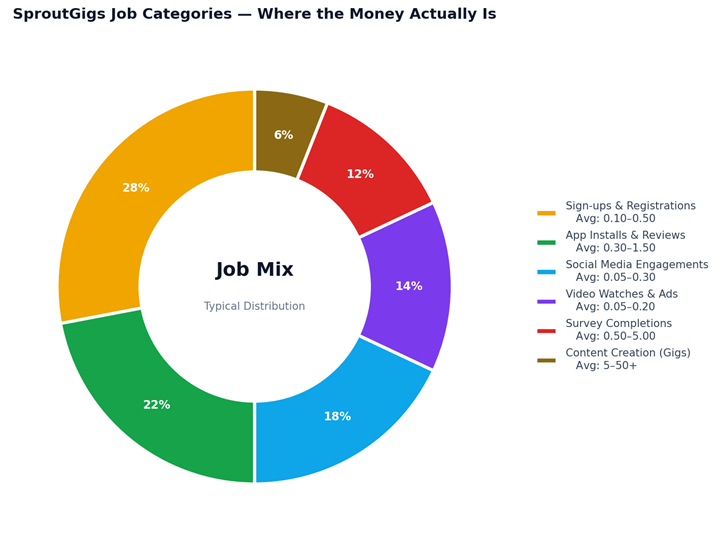
The typical job mix on SproutGigs and the average pay range for each category. Sign-ups and app installs dominate the entry-level pool, but surveys and content gigs pay the most per task.
Step 6: Use the Referral Program Without Being Annoying
SproutGigs runs a Refer and Earn program that pays you roughly 5 percent of your referrals’ earnings for as long as they remain active, paid out of SproutGigs’ cut rather than deducted from the referred freelancer. The passive income potential is modest but real: I have referred 12 people, 4 of whom became active, and those referrals now generate roughly $15 to $25 per month with zero ongoing effort. The key is to refer people who will actually use the platform seriously, not to spam your link in Facebook groups full of people looking for get-rich-quick schemes.
Step 7: Master the 30-Second Submission Interval
SproutGigs enforces a minimum submission interval between tasks to prevent bots from spamming the platform, and my interval is set to 30 seconds. This sounds annoying, but it is actually a productivity tool in disguise. The 30-second window forces me to slow down, double-check my proof, and pick my next task deliberately rather than reflexively clicking through the job pool. I use that 30 seconds to read the next task’s instructions, prepare screenshots, and make sure I understand what the buyer wants. Freelancers who try to game the interval by submitting sloppy work are the ones whose satisfaction rates collapse within a month.
How My Earnings Actually Grew Over Six Months
I want to show you exactly how my earnings curve looked over six months, because the shape of that curve is the most important thing to understand about SproutGigs. The chart below plots my cumulative and monthly earnings from month one through month six, with my freelancer level at each point noted along the x-axis. The shape is not linear — it is exponential, and the inflection point happens at Level 3, which is where higher-paying jobs start appearing in the feed with any regularity.
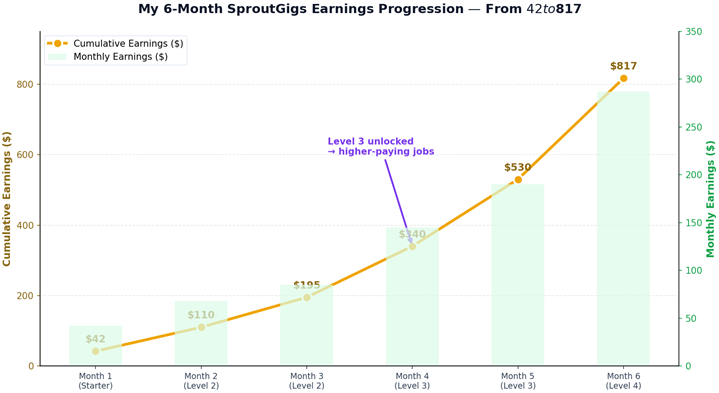
My actual SproutGigs earnings over six months. The curve bends sharply upward at Level 3, which is when Featured and Power Jobs become a regular part of the job pool.
Look at the gap between month three ($195 cumulative) and month four ($340 cumulative). That single month added $145 to my total — more than my entire first month produced. The reason is that I crossed from Level 2 to Level 3 in the middle of month four, and almost overnight the job pool visibly changed. Tasks I had never seen before — $1.50 to $3.00 app install jobs, $2.00 to $4.00 content gigs, $3.00 to $5.00 Power Jobs with auto-verification — started showing up. By month five, I was clearing $45 to $60 per week working the same hours I had been working in month two when I was earning $15 a week. The platform rewards consistency and patience, not hustle and volume.
The Mistakes That Quietly Destroy SproutGigs Accounts
I want to spend a section on the mistakes I made and the mistakes I watched other freelancers make, because these are the silent account-killers that nobody talks about. The chart below shows the relationship between satisfaction rate and job access — and it should make it viscerally clear why every Not Satisfied rating is more expensive than it looks.
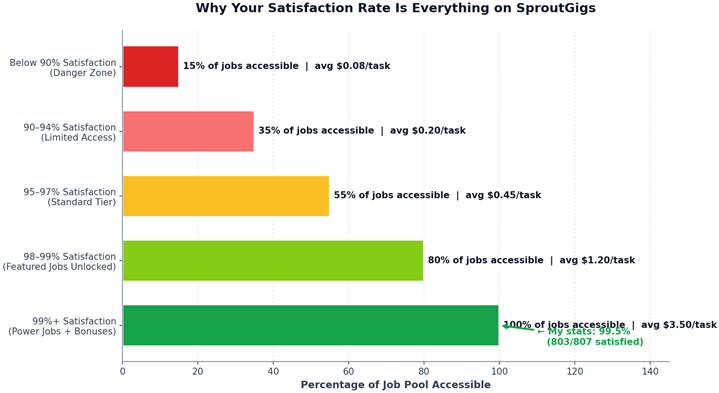
How your satisfaction rate controls your earning potential on SproutGigs. Below 90 percent is a death spiral; above 99 percent unlocks Power Jobs and the $3 to $5 pay tier.
The first mistake is submitting tasks too fast. SproutGigs tracks submission patterns, and if you complete tasks in 20 seconds that the buyer estimated would take 5 minutes, the platform flags your account even if the work is correct. I learned this the hard way in month two when I blitzed through a batch of sign-up tasks in 15 minutes and got a warning email from SproutGigs support. The work was fine, but the speed was not, and the warning stayed on my account for 30 days. Now I deliberately pace myself — even on tasks I could complete in 30 seconds, I spend at least 90 seconds before hitting submit.
The second mistake is ignoring task instructions. Tasks get rejected because the freelancer submitted a screenshot of the wrong screen, used the wrong format for proof, or skipped a step the buyer explicitly listed. The worst offenders are tasks that ask for a specific word or phrase in a comment — buyers run automated checks, and if your comment does not contain the exact string they specified, you get Not Satisfied with no chance to fix it. My rule is to copy the exact instruction text into a notes file, complete the task, then check my submission against the instruction word for word before submitting.
The third mistake is going inactive for too long. SproutGigs’ level system includes a decay mechanic — if you do not complete any tasks for around 30 days, your level starts to decrease. I took a two-week vacation in month four and came back to find my job pool had visibly shrunk. The fourth mistake is using a VPN. SproutGigs’ anti-fraud system aggressively flags VPN connections, and buyers specify geographic targeting for most tasks. Use a stable residential connection from a single location, accept that you will only see jobs targeted to your country, and do not try to game the system.
How Withdrawals Work (And What Actually Hits Your Bank)
Earnings mean nothing if you cannot get the money out. SproutGigs supports five withdrawal methods: Lightning (Tipalti), Airtm, Skrill, PayPal, and direct crypto. The minimum withdrawal threshold is $5 for most methods and $2 for crypto. I use Lightning exclusively because it has the fastest processing time (typically 24 to 48 hours from request to funds in my bank account) and the lowest fees (SproutGigs charges a flat 5 percent withdrawal fee, and Tipalti adds a small processing fee). My withdrawals have reliably hit my bank account within 3 business days, and I have not had a single failed withdrawal in six months. Your first withdrawal may take longer than subsequent ones, because SproutGigs runs additional fraud checks on initial withdrawals from new accounts.
The withdrawal process itself is straightforward. From your Wallet page, click Withdraw, select your method, enter the amount, and submit. The platform processes withdrawals in batches, with most requests handled within 24 hours. You will receive an email when the withdrawal is initiated, and a second email when the funds are dispatched. The whole flow is more professional than I expected — I had been burned by shady micro-task platforms in the past that made withdrawals deliberately difficult. One important note: SproutGigs does not withhold taxes and does not issue 1099 forms. You are responsible for tracking your own earnings and reporting them according to your local tax laws.
How Much Can You Realistically Earn on SproutGigs?
I want to end the tactical part of this guide with a realistic earnings breakdown, because the internet is full of SproutGigs reviews claiming absurd numbers that bear no relationship to what an actual beginner can expect. Here is what I believe is achievable for someone treating the platform as a serious side hustle, working one to two hours a day, five days a week, for six months. In month one, expect $30 to $60 — you will be grinding Level 1 Starter tasks at $0.05 to $0.30 each. In month two, expect $60 to $120 as you cross into Level 2. In month three, expect $100 to $200 as Level 2 stabilizes. In month four, expect $150 to $300 as you cross into Level 3 and Featured Jobs become regular. In month five, expect $200 to $400 as Power Jobs start appearing. In month six, expect $250 to $500 as your Level 4 access matures.
Adding those ranges gives a six-month total somewhere between $790 and $1,580, which brackets my actual $817 closely enough that I am confident the numbers are honest. The wide range reflects the variance in job availability, country targeting (US, UK, Canada, and Australia-based freelancers see significantly more jobs than freelancers in other regions), and individual discipline. If you live in a high-targeting country, are willing to grind through Level 1 without quitting, and treat your satisfaction rate as sacred, the upper end is genuinely achievable. There is no version of SproutGigs where you earn $1,000 in your first month without already having an established account — anyone telling you otherwise is selling a course.
Realistic expectation: $800 to $1,500 over your first six months, working 1 to 2 hours a day. Anyone promising faster results is either lying or selling you a course that does not work. The platform rewards patience, not hustle.
Honest Pros and Cons After Six Months
No platform is perfect, and SproutGigs is no exception. I want to close with an honest assessment of what the platform does well and where it falls short, because I have been writing this article as a genuine recommendation rather than a hit piece, and a real recommendation includes the warts. The pros and cons below reflect six months of daily use, dozens of withdrawals, and conversations with other freelancers in the platform’s community.
- Genuinely accessible to beginners — no portfolio, no application required to start.
- Real payment proof — I have withdrawn over $800 without a single failed payout.
- The level system creates a real progression curve that rewards consistent quality work.
- Auto-verification on Power Jobs means fast payment clearance and earn point accumulation.
- Low minimum withdrawal threshold ($5 for most methods) means quick access to your money.
- Referral program adds genuine passive income if you refer serious users.
Now the cons, because they matter. The Level 1 grind is genuinely exploitative — there is no polite way to describe paying someone $0.05 to watch a 30-second video. The platform’s geographic targeting means freelancers in lower-income countries see dramatically fewer jobs than US-based freelancers. The 5 percent withdrawal fee adds up over time — I have paid roughly $40 in fees on my $817 in earnings. Customer support is slow — I had a question about a withdrawal in month three and it took 11 days to get a response. And the decay mechanic on levels means you cannot take extended breaks without losing access, which makes SproutGigs a poor fit for people who want occasional side income rather than a consistent daily commitment.
- Level 1 pay rates are genuinely exploitative — expect $1 to $2 per hour in your first month.
- Geographic targeting means non-US freelancers see significantly fewer available jobs.
- 5 percent withdrawal fee plus processor fees can eat 7-10 percent of your earnings.
- Customer support is slow — expect 7 to 14 day response times on non-urgent tickets.
- Level decay means extended breaks (30+ days) will cost you hard-earned level progress.
- Survey disqualification rates are high — 40 to 60 percent of attempted surveys may not credit.
Final Thoughts: Should You Actually Try SproutGigs?
I am going to end this guide the way I started it — with honesty rather than hype. SproutGigs is not going to make you rich. It is not going to replace a full-time job. What it can be, with the right expectations and the right system, is a reliable $200 to $500 a month side income that costs you nothing to start, requires no special skills, and pays out in real money to your actual bank account. For someone in a high-income country looking for occasional beer money, that is a modest win. For someone in a lower-income country where $300 a month meaningfully changes your standard of living, it can be transformative. The platform does not care who you are — it cares whether you complete tasks correctly, maintain your satisfaction rate, and show up consistently.
If you decide to try it, here is my final piece of advice. Commit to 30 days before you judge the platform. Do not look at your earnings total during those 30 days — it will be demoralizing. Focus instead on your satisfaction rate, your task completion count, and your earn points. Treat every single task as if your entire account depends on it, because in the early levels, it does. Use the 30-second submission interval as a built-in quality control pause. Read every task instruction twice. Take the screenshots. Submit clean proof. Do those things for 30 days, and you will reach Level 2 with a satisfaction rate above 95 percent.
I will not pretend SproutGigs is for everyone. It requires patience most people do not have, tolerance for boring repetitive work, and a willingness to delay gratification that the modern internet has trained out of us. But for the small percentage of people who can stomach the Level 1 grind and treat the platform as a long game rather than a quick score, SproutGigs is one of the few honest micro-task marketplaces left on the internet. It paid me $817 over six months, reliably, without a single shady withdrawal or unfair rejection. In a corner of the internet littered with scams and broken promises, that counts for something. If you decide to try it, I wish you better luck than I had in those first painful weeks — and I hope to see you in the Level 4 job pool soon.