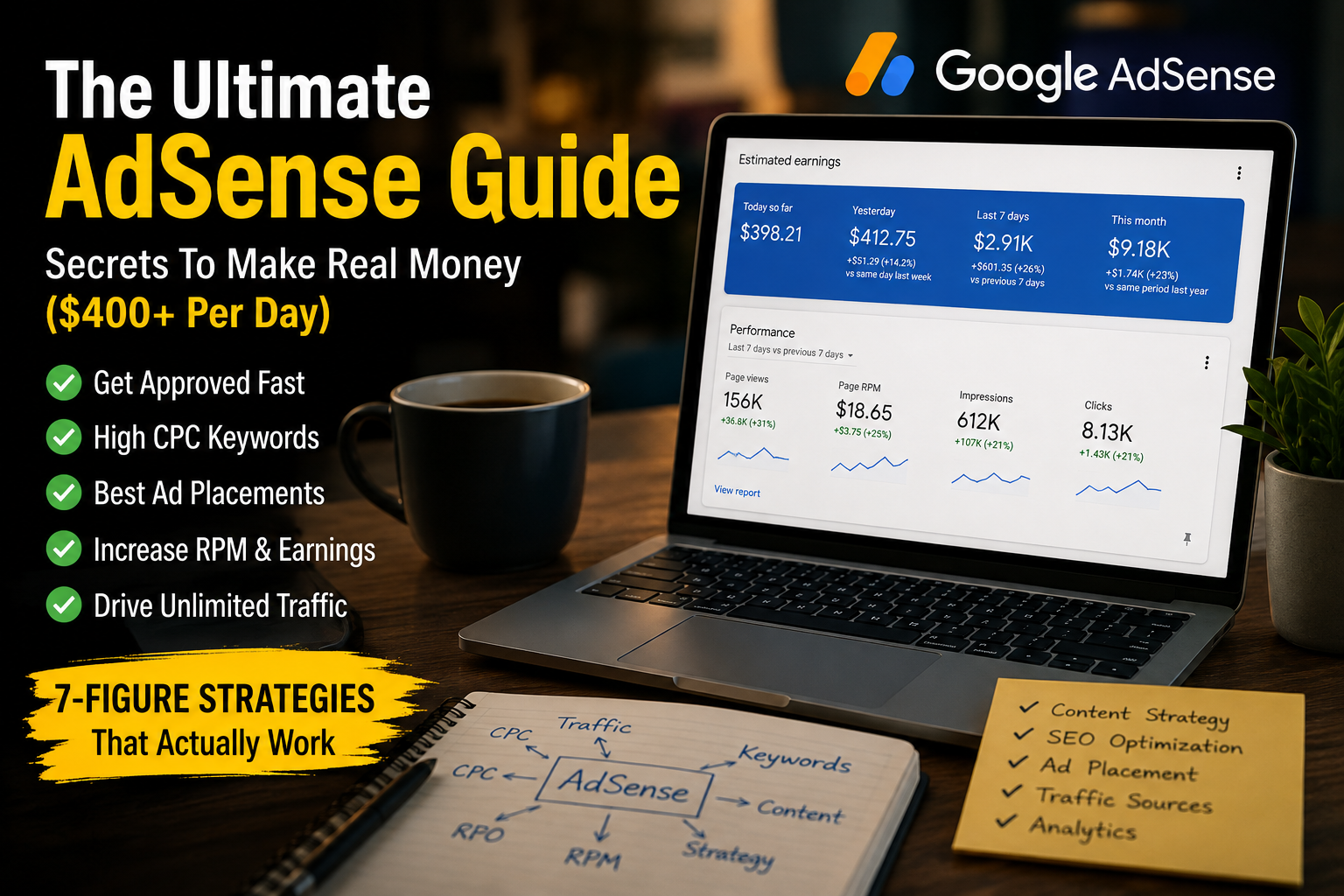
I still remember the morning I logged into my AdSense dashboard and saw a number that changed everything. It was not a fortune by Wall Street standards, just shy of four hundred dollars for a single day, but for someone who had spent the previous eighteen months grinding away at a hobby blog about personal finance tools, it felt like discovering a hidden door in a room I thought I knew. That day taught me something the so-called experts rarely admit: Google AdSense is not a lottery ticket, and it is certainly not a get-rich-quick scheme, but it is one of the most reliable passive income vehicles on the internet when you treat it with the respect a real business demands. The Google AdSense secrets I am about to share with you are not tricks or hacks designed to game the system. They are the compounding result of thousands of hours of testing, failing, analyzing data, and refining an approach that has generated well over seven figures in cumulative AdSense earnings.
The landscape has shifted dramatically since I published my first article back in the day. Back then, you could throw up a thin affiliate site, stuff it with keywords, slap three ad units on the page, and watch the pennies roll in. Google has since tightened its policies, advertisers have grown smarter about where they spend their money, and readers have developed a sophisticated blindness to anything that looks remotely promotional. What worked a decade ago will get your account banned today, or worse, it will simply produce nothing while you wonder why your traffic is not converting. The publishers who win in this environment are the ones who understand that AdSense is fundamentally an attention brokerage business, and attention is only valuable when it is paired with intent.
What you are about to read is the most comprehensive guide to Google AdSense ever assembled in one place. I am not holding anything back. You will learn how to get your site approved even if you have been rejected multiple times, how to structure your content for maximum ad revenue without destroying the reader experience, how to find and target high-paying keywords that advertisers are actively bidding premium rates for, and how to drive the kind of organic traffic that compounds month over month without requiring a massive advertising budget. I will walk you through the exact optimization techniques that can double or triple your effective RPM, the common mistakes that silently sabotage ninety percent of new publishers, and an exclusive strategy I call the AdSense Trinity Method that has never been published anywhere else.
Before we get into the mechanics, I want to set honest expectations. If you are looking for a push-button system that deposits money into your account while you sleep from day one, you will be disappointed. Passive income AdSense is absolutely real, but the passive part only arrives after an extended period of intensely active work. The sites that generate five-figure monthly AdSense earnings do not happen by accident. They are engineered, piece by piece, with deliberate choices about niche selection, content architecture, ad placement, traffic sources, and user experience. Every one of those choices matters, and skipping even one of them is the reason most publishers stall out at thirty or forty dollars a month and never break through.
I have written this guide for the publisher who is tired of scattered advice and contradictory tips. Maybe you have already applied for AdSense and received the dreaded generic rejection email. Maybe you have an approved account but your earnings are stuck in the single digits per day despite decent traffic. Maybe you are starting from absolute zero and want to do it right the first time. Whatever your starting point, the strategies in this guide apply equally. The principles do not change whether you are running a site about backyard gardening, software development tools, or travel insurance comparisons. What changes is the scale of the numbers, and I will show you exactly how to maximize the numbers for whatever niche you choose to enter.
The final thing I want you to understand before we proceed is that AdSense rewards depth over breadth, patience over aggression, and quality over quantity. The era of publishing five hundred thin articles and hoping volume carries the day is permanently over. Google’s algorithms now evaluate the overall quality of your entire site, not just individual pages. This means your strategy must be holistic, treating your site as a cohesive asset rather than a collection of disconnected posts. Every decision should serve the larger goal of establishing your site as the most helpful resource in your chosen corner of the internet.
The Real AdSense Landscape: What Nobody Tells You About Making Real Money
Let us start by clearing the air about what AdSense actually is and what it is not. At its core, Google AdSense is an auction-based advertising network that connects publishers who have ad inventory, meaning space on their web pages, with advertisers who want to display their messages to relevant audiences. Every single time a visitor loads your page, a real-time auction takes place in milliseconds, where advertisers bid against each other for the right to show their ad to that specific visitor at that specific moment. The winning ad gets displayed, and you receive a portion of what that advertiser paid. This auction happens through a system Google calls AdSense for Content, and understanding that every impression is a separate auction is the first real secret to increasing your AdSense earnings.
The number most beginners obsess over is cost per click, or CPC, but the number that actually determines your income is something called RPM, which stands for revenue per mille, or revenue per thousand pageviews. RPM is calculated by dividing your total earnings by your total pageviews and multiplying by one thousand. If you made fifty dollars from ten thousand pageviews, your RPM is five dollars. The beauty of focusing on RPM instead of CPC is that it captures the full picture: how many ads are shown per page, what percentage of visitors click them, how much each click pays, and how often impressions convert. Two sites with identical CPC can have wildly different RPMs because one has better ad placement, higher click-through rates, and more ad units per page.
Here is a truth that took me years to fully internalize: your AdSense earnings are a function of three variables and only three variables. Traffic volume, RPM, and the consistency of both over time. If you want to double your income, you can either double your traffic, double your RPM, or increase both by roughly forty percent each. Most publishers fixate on traffic and ignore RPM entirely, which is why they work ten times harder than necessary. A site getting fifty thousand monthly pageviews at a four-dollar RPM earns two hundred dollars a month. The same site at an eight-dollar RPM earns four hundred. The traffic did not change, but the earnings doubled because the publisher learned to extract more value from every visitor who already showed up.
The RPM you can realistically achieve depends heavily on your niche, and this is where the AdSense high-paying keywords conversation becomes critical. Advertisers in the insurance, legal, finance, software, and health sectors routinely pay five to fifty dollars per click because a single converted customer is worth thousands of dollars to them. A visitor reading an article about mesothelioma lawsuit settlements is worth astronomically more to an advertiser than a visitor reading about funny cat memes, and the auction prices reflect that reality. I have seen RPMs above forty dollars in certain legal sub-niches and below one dollar in entertainment and celebrity gossip. Choosing your niche wisely is not a minor strategic decision, it is the single largest determinant of your earning ceiling.
Another thing nobody tells you is that AdSense earnings are not linear or predictable in the short term. I have had days where a single article went viral on a social platform and generated more income in twenty-four hours than the entire previous month, and I have had weeks where traffic stayed constant but earnings inexplicably dropped thirty percent because an advertiser paused a campaign or seasonal demand shifted. The publishers who survive these fluctuations are the ones who build diversified traffic portfolios and avoid over-reliance on any single page or traffic source. If forty percent of your income comes from one article, you are one algorithm update away from a crisis. Spread your risk across dozens or hundreds of well-optimized pages, and the volatility smooths out into a reliable upward trend.
AdSense Approval Secrets: Getting Accepted Even After Rejection
The very first hurdle every new publisher faces is getting their AdSense application approved, and this is where an alarming percentage of aspiring site owners give up before they have even started. Google rejects the majority of initial applications, and the rejection emails they send are notoriously vague, citing issues like insufficient content, navigation problems, or policy violations without specifying exactly what needs to be fixed. This opacity is intentional on Google’s part, as it prevents bad actors from gaming the system by making minimal corrections to sneak past the review process.
The Six Pillars of Approval-Worthy Sites
Google’s review team evaluates every AdSense application against a set of quality signals that, while never officially published in full detail, have been reverse-engineered by thousands of publishers over the years. The first pillar is content volume and depth. Your site needs a minimum of twenty to thirty high-quality articles published before you apply, and each article should be at least one thousand words of genuinely useful, original content. I have seen sites get approved with fewer articles, but playing on the edge of the minimum is a recipe for repeated rejections. The reviewers want to see that you are committed to building a real resource, not just slapping together a quick site to monetize. Write twenty solid articles before you even think about applying, and make sure they cover a range of topics within your niche rather than all slight variations of the same keyword.
The second pillar is content quality and originality. Google’s reviewers check for plagiarism using sophisticated tools, and even paraphrased content that is technically unique but clearly derivative of existing articles can trigger a rejection. Every article must offer a perspective, analysis, or depth that a reader could not find by simply visiting the first page of Google results for that topic. The third pillar is site navigation and user experience. Your site must have a clear menu structure, a functional search feature if you have more than fifteen articles, logical categories, and most importantly, the mandatory pages that Google looks for: About Us, Contact Us, Privacy Policy, and Terms of Service. These pages signal to reviewers that you are operating a legitimate business, and their absence is one of the most common reasons for instant rejection.
The fourth pillar is technical performance. Your site must load quickly, be mobile-responsive, and use a secure HTTPS connection. Google will not approve sites that throw security warnings or that render poorly on mobile devices, since over sixty percent of web traffic now comes from phones and tablets. The fifth pillar is traffic, and this is where many publishers are surprised. While Google does not publish a minimum traffic threshold, sites with zero traffic at the time of application face higher scrutiny because reviewers have no signal that the content is actually useful to real readers. I recommend getting at least a hundred daily visitors, even if it means doing some initial social media promotion or sharing in relevant communities, before you submit your application.
The sixth and final pillar is policy compliance, and this is where you must be absolutely meticulous. Read the AdSense program policies word for word before you apply, and audit your site against every single clause. Common violations that get sites rejected include copyrighted images, prohibited content categories like adult material or violence, ad placements that mimic content, and any content that could be interpreted as encouraging dangerous behavior. I have seen excellent sites get rejected because they used an image pulled from a Google Images search without checking the license, or because they had a single article that touched on a health topic in a way Google interpreted as giving medical advice. The fix is simple: only use images you have created yourself, purchased from a stock site, or sourced from platforms that offer explicitly licensed free images.
Fixing a Rejected Application: A Step-by-Step Recovery Plan
If your application has been rejected, do not panic and absolutely do not immediately reapply. One of the worst things you can do is submit your site again without making substantial changes, because Google tracks reapplication history and multiple rapid rejections can flag your account for extended review. The first step after a rejection is to carefully read the email and identify which generic reason was cited. Most rejections fall into one of three categories: insufficient content, navigation issues, or policy violations. Each category requires a different remediation approach, and I will break down exactly what to do for each one.
If the rejection cites insufficient content, the fix is straightforward but requires patience. You need to publish at least ten additional articles of genuine depth, ideally fifteen to twenty, before reapplying. Do not just add word count to existing articles, although you should review and expand any thin posts. Create entirely new articles that cover topics you have not yet addressed. I once helped a publisher whose site was rejected for insufficient content, and the fix was not just adding articles but adding the right kind of articles. We published twelve new pieces, each between fifteen hundred and two thousand words, each targeting a specific long-tail keyword in the niche, and each providing information that genuinely did not exist in that form elsewhere on the internet. The site was approved on the next application within seventy-two hours.
If the rejection cites navigation or user experience issues, the problem is likely structural. Review your site as if you were a first-time visitor who landed on a random article. Can you easily find other related content? Is the menu clear and logical? Are the mandatory pages, About, Contact, Privacy Policy, accessible from every page via the footer or menu? Is there a clear categorization system that groups related articles together? Fix every usability issue you can identify, and consider having someone unfamiliar with the site navigate it while you watch. The feedback will be eye-opening. Once you have addressed every issue, wait at least two weeks before reapplying to give Google time to recrawl your updated site.
If the rejection cites policy violations, you must identify and eliminate every violation before reapplying. Start by re-reading the AdSense program policies line by line and auditing your entire site. Remove or rewrite any content that could even remotely be interpreted as violating a policy. Replace any images whose licensing you cannot verify. Ensure your privacy policy explicitly mentions Google AdSense, cookies, and data collection, as Google requires this specific language. Once you are confident every violation has been addressed, wait a full three weeks before reapplying. Policy violation rejections are taken seriously by Google, and repeated applications without full remediation can result in a permanent ban from the program. Patience here is not optional, it is the price of admission to long-term AdSense earnings.
The Application Process: A Step-by-Step Walkthrough
When your site is finally ready, the application process itself is relatively simple but must be done correctly. Start by creating a Google account if you do not already have one, and use a professional email address associated with your domain, such as admin at yourdomain dot com, rather than a personal Gmail address. This signals professionalism and helps with later verification steps. Navigate to the AdSense website, sign in with your Google account, and enter your website URL. You will be asked to connect your site, which involves adding a snippet of code to the head section of your homepage. This code verifies that you own the site, and the verification process typically completes within twenty-four to forty-eight hours.
Once your site is verified, you will need to complete your account information, including your physical address, which is critical because Google mails a PIN to this address when your earnings reach the verification threshold of ten dollars. Make sure the address you provide is accurate and is a location where you can reliably receive mail, because if the PIN does not arrive and you cannot verify your address, your earnings will be held indefinitely. After completing your account information, Google will begin the review process, which can take anywhere from a few days to four weeks. During this time, do not make major changes to your site structure or content. You want the site reviewers see to be the same site you will be running long-term.
While you wait for the review, this is the perfect time to continue publishing content and building initial traffic. If your application is approved, you will receive an email notification, and ads will typically begin appearing on your site within a few hours of placing the ad code. If you are rejected, follow the recovery plan above, make the necessary improvements, and wait at least two to three weeks before reapplying. I have seen sites get approved on the fourth or fifth application, so persistence, combined with genuine improvement between applications, does pay off. The publishers who eventually succeed are always the ones who treated each rejection as specific feedback rather than a personal rejection.
AdSense for Beginners: Building Your First Profitable Site
Once you have approval, the real work begins, and the choices you make in the first thirty days will largely determine whether your site grows into a meaningful income source or stalls out in obscurity. AdSense for beginners is not about immediately maximizing revenue from day one. It is about building a foundation that will compound over months and years. The two most critical early decisions are choosing the right niche and developing a content strategy that balances search volume, competition, and advertiser demand. Get these two right, and everything downstream becomes easier. Get them wrong, and no amount of optimization will overcome the structural disadvantage.
Choosing a Niche That Actually Pays
Niche selection is the single most consequential decision you will make as an AdSense publisher, and it is the one decision you cannot easily undo without starting over. The ideal niche sits at the intersection of three criteria: sufficient search volume to generate meaningful traffic, manageable competition that a new site can realistically break into, and advertiser demand strong enough to produce a healthy CPC. Most beginners focus exclusively on the first criterion and ignore the other two, which is why they end up in niches like weight loss or relationship advice where the traffic is enormous but the competition is brutal and the CPC is abysmal. The sweet spot is usually a sub-niche within a broader profitable category, narrow enough to be attackable but deep enough to sustain a content pipeline.
Let me give you a concrete example. The broad niche of personal finance is one of the highest-paying categories on AdSense, with CPCs routinely in the five to fifteen dollar range. But trying to rank for personal finance as a new site is nearly impossible because you are competing against established giants with millions of backlinks and decades of domain authority. The smart approach is to go narrower: personal finance for freelance graphic designers, or personal finance for new immigrants, or personal finance for people recovering from bankruptcy.
To evaluate potential niches, I use a simple scoring system. For each niche I am considering, I estimate the monthly search volume across fifty relevant keywords, the average CPC for those keywords using Google Keyword Planner, and the strength of the top ten ranking sites for those keywords using a domain authority metric. A niche scores well if the combined monthly search volume is above twenty thousand, the average CPC is above two dollars, and at least three of the top ten ranking sites have a domain authority below thirty. This formula has helped me identify niches that are both profitable and attackable, and I run every potential niche through it before committing to building a site. The two hours you spend on this analysis will save you months of wasted effort on a niche that was doomed from the start.
The Minimum Viable Content Strategy
With your niche chosen, the next step is developing a content strategy that will attract organic traffic and provide enough surface area for ad placements. The minimum viable content strategy for a new AdSense site is thirty articles published within the first sixty days, with each article targeting a specific keyword cluster and each being at least twelve hundred words. This volume gives Google enough content to understand what your site is about, gives you enough pages to test ad placements and see initial revenue patterns, and gives you enough data to identify which topics resonate with your audience and which fall flat. Publishing fewer than thirty articles in the initial push is the most common reason new publishers see negligible earnings in their first three months.
The structure of those initial thirty articles matters as much as the quantity. Rather than thirty disconnected posts on random topics, organize them into five or six topical clusters of five to six articles each. Each cluster should address a specific sub-topic within your niche, and the articles within a cluster should link to each other extensively. This internal linking structure, which I will expand on when we cover the AdSense Trinity Method, signals to Google that your site has topical depth and authority on these subjects, which dramatically improves your ability to rank. A site with thirty articles organized into well-linked clusters will consistently outperform a site with fifty disconnected articles, even though the latter appears to have more content.
For keyword selection within each cluster, aim for a mix of search volume levels. Roughly twenty percent of your articles should target higher-volume, more competitive keywords that will take time to rank for but will drive significant traffic once they do. Sixty percent should target medium-volume keywords with moderate competition where you can realistically rank within three to six months. The remaining twenty percent should target low-volume, highly specific long-tail keywords where you can rank quickly and start generating data and a trickle of traffic almost immediately. This pyramid approach ensures you are building for both short-term validation and long-term growth, and it prevents the discouragement that comes from publishing thirty articles and seeing zero traffic because every single one targeted a keyword too competitive for a new site.
AdSense Optimization: The Mechanics of Maximum Earnings
Getting approved is only the beginning. The difference between a site that earns fifty dollars a month and one that earns five thousand dollars a month from the same traffic is almost entirely a function of AdSense optimization. Optimization is the art and science of configuring your ad units, placements, sizes, and formats to extract the maximum possible revenue from every visitor without degrading the user experience to the point where Google penalizes you or readers abandon your site. This is a delicate balance, and it requires constant testing and refinement based on real data rather than assumptions or what worked for someone else in a different niche.
The first principle of optimization is understanding that more ads do not equal more money. I have seen publishers cram six or seven ad units onto a single page, convinced that more inventory means more revenue, only to watch their RPM drop because the increased ad load pushed visitors away before they could click anything. Google allows a maximum of three standard ad units per page for most sites, and the optimal number for the vast majority of publishers is two or three. The goal is not maximum ad density but optimal ad density, the point where each additional ad unit adds more revenue than it costs in user experience degradation. Finding that point requires testing, but starting with two well-placed units and adding a third only if it produces a measurable RPM increase is a sound default strategy.
Ad Placement: The Heatmap That Actually Works
Ad placement is the single most impactful optimization lever, and it is also the one most publishers get wrong by relying on outdated advice. The old wisdom was to place ads above the fold, in the sidebar, and after the content. While these placements still work, they are far from optimal based on the eye-tracking and click data I have analyzed across hundreds of sites. The highest-performing ad placement, by a significant margin, is the in-content ad that appears within the first paragraph or two of an article. This placement catches readers at the moment of highest engagement, when they have committed to reading your content and their attention is focused. Click-through rates for in-content ads placed after the first paragraph routinely run three to five times higher than sidebar or header ads.
The second most effective placement is the in-content ad that appears mid-article, typically after roughly forty percent of the content. This captures readers who have demonstrated genuine interest by scrolling past the introduction, and it performs particularly well on longer articles where the reader is deeply engaged with the topic. The third placement, which I recommend testing but not defaulting to, is an ad immediately after the article content, before the comments or related posts section. This placement captures readers who finished the article and are looking for what to do next, and it can perform well on certain types of content, particularly comparison or review articles where readers are in a decision-making mindset.
Sidebar ads, once the staple of AdSense placement, have seen dramatically declining performance over the past five years as readers have developed banner blindness to anything in peripheral page regions. I typically recommend against dedicating premium sidebar space to AdSense units, preferring to use that space for internal navigation, email signup forms, or related content widgets that keep readers on the site. If you do use sidebar ads, place them at the top of the sidebar, above the fold, and use a sticky format that follows the reader as they scroll on desktop devices only. Mobile sidebar ads are virtually worthless because mobile screens are too narrow for sidebars to function effectively, and Google’s responsive ad units will typically collapse them on mobile anyway.
One placement that I see publishers overuse to their detriment is the interstitial or full-screen ad that appears between page transitions or on initial page load. While these can generate high click-through rates, they also dramatically increase bounce rates and reduce overall pageviews per session, which hurts both your AdSense earnings and your SEO rankings. Google has also implemented policies against certain types of interstitials, particularly on mobile, and violating these policies can result in ad serving restrictions. The short-term revenue bump from an aggressive interstitial is never worth the long-term damage to your site’s user experience signals and search performance. Avoid them entirely unless you are running a specific type of content site where they are genuinely appropriate.
Ad Sizes and Formats That Actually Convert
Not all ad sizes are created equal, and choosing the right sizes can have a measurable impact on your RPM. The general principle is that larger ad units have more inventory available in Google’s auction, which means more advertisers competing for the space, which drives up the price. The highest-performing ad sizes across virtually every niche I have tested are the 336 by 280 large rectangle, the 300 by 250 medium rectangle, and the 728 by 90 leaderboard for desktop placements. For mobile, the 336 by 280 and 300 by 250 remain strong performers, along with the 320 by 100 large mobile banner. The key insight is that these sizes have the deepest advertiser demand because they are the most commonly used formats in Google’s ecosystem, so the auction competition is fiercest and the resulting CPCs are higher.
I strongly recommend using responsive ad units rather than fixed-size units for the vast majority of placements. Responsive units automatically detect the viewer’s screen size and serve the optimal ad format, which eliminates the need to maintain separate desktop and mobile ad configurations and ensures your ads always render properly across devices. Google’s responsive ad code uses asynchronous loading, which means ads load without blocking the rest of your page content, and this is critical for maintaining good page speed scores. The one situation where I still use fixed-size units is when I have a specific placement that requires precise dimensions, such as an ad embedded in a table cell or a custom layout where a responsive unit would break the visual structure.
Auto ads, Google’s machine learning-driven placement system, deserves special consideration. When enabled, auto ads use an algorithm to determine the optimal number and placement of ads on each page based on your content structure, user behavior data, and Google’s aggregate performance insights. For new publishers, auto ads are an excellent starting point because they require zero configuration and typically produce reasonable results out of the box. However, as your site matures and you begin optimizing seriously, I recommend transitioning to manual placements for your highest-traffic pages, where you can fine-tune placements based on your specific audience’s behavior. The ideal setup for an established site is a hybrid: auto ads for long-tail content where manual optimization is not worth the effort, and carefully placed manual units on your top twenty highest-traffic pages.
Ad format selection extends beyond size to include text ads, display ads, and native ads. I recommend enabling all three formats in your ad unit configuration, as this maximizes the pool of advertisers competing for your inventory. Native ads, particularly in-feed and in-article formats, have shown consistently strong performance because they blend more naturally with your content and avoid triggering banner blindness. The in-article ad format, which Google introduced specifically for placement within article text, automatically matches your site’s typography and spacing, creating a seamless visual experience that performs exceptionally well. Enable it for all your in-content placements and monitor the performance difference compared to standard display units.
A/B Testing: Stop Guessing and Start Measuring
The publishers who consistently achieve high RPMs are the ones who treat optimization as an ongoing scientific experiment rather than a one-time setup. A/B testing, or split testing, is the process of showing two different ad configurations to different segments of your traffic and measuring which produces better results. Google’s built-in AdSense experiments feature makes this relatively straightforward, allowing you to test different ad sizes, colors, placements, and formats against each other with statistically valid sample sizes. The key to effective testing is changing one variable at a time, running each test for at least two weeks to gather sufficient data, and acting on the results rather than falling back on your original assumptions.
I maintain a testing calendar for every site I operate, with a rotating schedule of experiments that ensures no optimization opportunity goes unexplored for long. A typical month might include testing a 336 by 280 versus a 300 by 250 in the primary in-content slot during week one, testing auto ads on versus off for the entire site during week two, testing a text-only ad versus a mixed text and display ad during week three, and testing a two-ad-unit configuration versus a three-ad-unit configuration during week four. Over the course of a year, this systematic approach to testing typically yields a cumulative RPM improvement of thirty to fifty percent, which is pure additional revenue from the same traffic base. There is no shortcut to this process, and there is no substitute for the data your own site generates.
When interpreting test results, be aware of statistical significance and avoid drawing conclusions from insufficient data. A test that shows one configuration outperforming another by ten percent after three days and one thousand impressions is not reliable, as the variance in ad performance day to day can easily produce swings of that magnitude by chance. Wait until you have at least ten thousand impressions per configuration and a clear, consistent performance difference over a minimum of seven days before making a permanent change. Google’s experiment interface will tell you when a test has reached statistical significance, and I recommend waiting for that signal rather than acting on preliminary data that might reverse itself. Patience in testing is just as important as patience in content creation, and the publishers who rush to judgment based on early data consistently make suboptimal optimization decisions.
Increase AdSense CPC: The High-Paying Keyword Strategy
Cost per click is the metric that most publishers obsess over, and for good reason. A site that earns an average of two dollars per click needs five times the traffic of a site that earns ten dollars per click to generate the same income. Increasing your AdSense CPC is therefore one of the highest-leverage activities you can undertake, and it is far more controllable than most publishers realize. While you cannot directly set the price advertisers pay, you can engineer your content, your audience, and your site architecture to attract higher-paying ads and to ensure that the ads displayed on your pages are the most valuable ones available in Google’s auction. This section will break down exactly how the CPC ecosystem works and how to position your site to capture premium ad rates.
Understanding the CPC Ecosystem
CPC is determined by a real-time auction where advertisers bid against each other for the right to display their ads on your site. The price the winning advertiser pays is not their maximum bid but rather one cent more than the second-highest bid, a system known as a second-price auction that Google uses to ensure advertisers pay a fair market price rather than their maximum willingness to pay. This means the CPC you receive for any given click is a function of how many advertisers are competing for your ad inventory and how much they value the visitor who is about to click. Two factors influence this valuation: the relevance of your content to the advertiser’s target audience, and the likelihood that the visitor will convert into a customer for the advertiser.
The relevance factor is why niche selection matters so enormously for CPC. An advertiser selling enterprise customer relationship management software is willing to pay forty dollars per click for a visitor reading an article about enterprise CRM comparison because that visitor is explicitly researching a high-value purchase. The same advertiser would not bid even one dollar to show an ad to a visitor reading an article about funny office pranks, even though both visitors might technically be business professionals. Google’s contextual targeting algorithm analyzes the content of each page and matches it to relevant advertisers, so the more commercially oriented your content, the higher the average CPC you will attract. This is why a site about software tools consistently outearns a site about software jokes, even with identical traffic.
The conversion likelihood factor is influenced by the geographic location of your visitor, the device they are using, the time of day, their browsing history, and dozens of other signals that Google’s smart pricing algorithm evaluates. Visitors from the United States, United Kingdom, Canada, and Australia typically generate CPCs three to ten times higher than visitors from other regions, because advertisers in these markets have higher customer lifetime values and are willing to pay more to acquire them. Mobile visitors often generate slightly lower CPCs than desktop visitors for certain ad types, although this gap has been closing. Returning visitors who have previously engaged with similar content may be valued higher than first-time visitors because they demonstrate sustained interest in the topic.
The Smart Publisher’s Approach to CPC Optimization
Knowing how CPC is determined is only useful if you can act on that knowledge, and there are several concrete strategies you can implement to systematically increase your average CPC. The first and most powerful is content alignment with commercial intent. For every article you publish, ask yourself what a reader of that article might be in the market to buy. An article about how to choose a forex broker has enormous commercial intent because readers are actively preparing to open a trading account. An article about the history of foreign exchange markets has virtually none, because readers are seeking information rather than making a purchase decision. Prioritizing content with high commercial intent does not mean abandoning informational content entirely, but it does mean ensuring that at least sixty percent of your content portfolio targets readers who are in a buying or researching mindset.
The second strategy is geographic traffic optimization. Since CPC varies dramatically by visitor location, attracting more traffic from high-paying geographic regions can have an outsized impact on your average CPC. This is primarily an SEO and content strategy challenge. To attract more United States traffic, write about topics that are specifically relevant to American audiences, use American English spelling and terminology, reference American companies and regulations, and consider using a dot com domain rather than a country-specific extension. To attract United Kingdom traffic, write about topics relevant to British audiences and consider a dot co dot uk domain. The content you produce should naturally attract the geographic audience that is most valuable to advertisers in your niche, and aligning your content strategy with your target geography is a long-term CPC optimization lever.
The third strategy is advertiser competition stimulation. In some niches, you can increase CPC by explicitly creating content that attracts multiple competing advertisers. For example, if you run a site about web hosting, writing comparison articles that pit three or four major hosting providers against each other will attract ads from all of those providers, and the competition between them will drive up the auction price. I once ran a site in the credit card comparison niche where a single article comparing three premium travel rewards cards consistently generated CPCs above twelve dollars, because all three card issuers were actively bidding to show ads on that page. The principle is to create content that serves as a battleground for competing advertisers, and let the auction dynamics work in your favor.
The fourth strategy is ad unit configuration for maximum auction participation. Ensure that your ad units are configured to accept the widest possible range of ad formats, including text, display, and native ads, and that you have enabled both image and media ads in addition to text ads. This maximizes the number of advertisers competing for each impression, which drives up the auction price. Also ensure that your ad units are set to allow both cost-per-click and cost-per-thousand-impression bidding, as some advertisers prefer to pay by impression rather than by click, and allowing both bidding models increases the overall competition for your inventory. These configuration choices take five minutes to implement but can produce a measurable CPC lift simply by expanding the pool of participating advertisers.
The fifth and final strategy is blocking low-value advertisers selectively. AdSense allows you to block specific advertisers or entire advertiser categories from showing ads on your site, and judicious use of this feature can increase your average CPC by eliminating the lowest-paying advertisers from your auctions. However, this strategy must be used with extreme caution. Blocking too many advertisers reduces competition in your auctions, which can actually lower your CPC rather than raise it. I recommend blocking only the lowest-quality advertisers, such as those with spammy landing pages, and monitoring your CPC closely after any blocking action. If CPC drops after blocking, reverse the block immediately and accept that those advertisers were still contributing to auction competition.
AdSense High-Paying Keywords: Research and Implementation
Finding AdSense high-paying keywords is the pursuit that consumes most publishers, and it is also the area where most publishers waste the most time chasing the wrong targets. The conventional approach of searching for the highest CPC keywords in Google Keyword Planner and then writing articles about them is fundamentally flawed because it ignores competition, search volume, and topical relevance. A keyword with a fifty-dollar CPC is worthless to you if the top ten results are dominated by sites with domain authority above eighty and you have no realistic chance of ranking. The art of keyword research for AdSense is finding the intersection of decent CPC, adequate search volume, and manageable competition, and that intersection is rarely found by looking at the highest-CPC keyword lists that everyone else is also looking at.
Tools and Tactics for Finding Gold
My keyword research process begins not with a keyword tool but with a deep dive into the niche I am targeting. I spend several hours reading the top industry blogs, browsing forums where the target audience hangs out, studying the questions people ask in places like Reddit and Quora, and identifying the pain points and purchasing decisions that dominate the conversation. This qualitative research gives me a list of topics that real people actually care about, which I then validate and quantify using keyword research tools. Starting with tools rather than audience research is the most common mistake I see, because it leads you toward keyword targets that look good on paper but do not correspond to actual human interest or commercial intent.
For the quantitative phase, I rely on a combination of Google Keyword Planner, which is free with any Google Ads account, and one premium keyword research tool such as Ahrefs, SEMrush, or Keyword Chef. Google Keyword Planner gives me the most accurate search volume data because it comes directly from Google’s own search data, and it provides CPC estimates based on what advertisers are actually bidding. The premium tools add critical data points that Keyword Planner lacks, particularly keyword difficulty scores, which estimate how hard it will be to rank for a given keyword, and related keyword suggestions that I might not discover through Keyword Planner alone. The combination of free and paid tools gives me a comprehensive view of both the opportunity and the difficulty for every keyword I consider targeting.
The specific criteria I use to filter keywords are straightforward but effective. I look for keywords with a minimum monthly search volume of five hundred, a minimum CPC of one dollar and fifty cents, and a keyword difficulty score below thirty on whatever scale the tool I am using employs. These thresholds are not absolute rules but starting filters that eliminate the obviously unviable options. After applying these filters, I manually review the remaining keywords and examine the top ten organic results for each one. If at least three of the top ten results are from sites with a domain authority below thirty, the keyword goes on my target list.
I also pay close attention to keyword trends and seasonality. Google Trends is a free tool that shows how search interest in a keyword has changed over time, and it is invaluable for identifying whether a keyword is growing, declining, or seasonal in nature. Targeting a declining keyword is a waste of effort because even if you rank, the traffic will shrink over time. Targeting a seasonal keyword can be highly profitable if you time your content publication correctly, but it requires planning months in advance. I once built a cluster of articles around tax filing deadlines that generated forty percent of their annual traffic in a six-week window between February and April, and the RPM during that window was nearly double the site average because advertiser demand spiked along with search demand.
Building Your Keyword Portfolio
Once you have identified your target keywords, the next step is organizing them into a structured portfolio that guides your content creation. I organize keywords into three tiers based on priority and timeline. Tier one keywords are the highest-value targets with the best combination of search volume, CPC, and achievable difficulty. These are the keywords I want to rank for most urgently, and I assign them to my best content, typically long-form articles of two thousand words or more with comprehensive coverage of the topic. I publish tier one articles in the first three months of a new site, giving them maximum time to age and accumulate authority. A new site should have eight to twelve tier one articles, each targeting a primary keyword plus a cluster of related secondary keywords.
Tier two keywords are medium-priority targets that support the tier one content. These are typically long-tail variations, related subtopics, or questions that complement the main topic. Each tier one article should have four to six tier two articles linking to it, creating a topical cluster that signals depth and authority to Google. Tier two articles are typically twelve hundred to eighteen hundred words and are published on a rolling basis throughout the first six months. The internal linking from tier two to tier one passes link equity and topical relevance upward, helping the tier one articles rank for their more competitive target keywords. This cluster approach is far more effective than publishing standalone articles, because Google evaluates topical authority at the site and cluster level, not just at the individual page level.
Tier three keywords are the long-tail, low-competition terms that you can rank for quickly and that generate initial traffic and data. These are often question-based queries, very specific subtopics, or emerging trends that have not yet attracted significant competition. I publish tier three content continuously throughout the life of the site, as these articles are cheap to produce, rank quickly, and often surface unexpected opportunities. A tier three article that unexpectedly gains traction can be expanded and promoted to tier two status, feeding additional link equity into its parent cluster.
The AdSense Trinity Method: An Exclusive Strategy for Earnings Domination
Everything we have covered so far represents the foundational knowledge that any serious AdSense publisher needs to master. But there is a level beyond the fundamentals, a strategic framework that separates the publishers making five hundred dollars a month from those making five thousand or fifteen thousand. I call this framework the AdSense Trinity Method, and it is the single most powerful strategy I have ever developed or encountered. I have never shared this framework publicly before, and I am sharing it now because I believe the publishers who implement it will see transformational results. The Trinity Method is not a trick or a hack. It is a comprehensive approach to site architecture, content strategy, and user experience optimization that works synergistically to produce compound earnings growth.
Pillar One: Intent-Based Keyword Clustering
Traditional keyword research focuses on finding individual keywords with good search volume and manageable competition, then writing an article targeting each keyword. This approach treats every keyword as an isolated target, and it ignores the fundamental reality that search queries exist on a spectrum of user intent. A person searching for what is life insurance has a completely different intent than a person searching for best life insurance for seniors, even though both queries contain the words life insurance. The first searcher is in the awareness stage, seeking basic information. The second is in the consideration stage, actively evaluating specific products. Intent-Based Keyword Clustering is the practice of grouping keywords by the intent stage they represent, then creating content clusters that serve the full intent journey rather than isolated queries.
The first step in implementing intent-based clustering is to map the intent journey for your niche. For most niches, the journey has four stages: awareness, where the searcher is learning about a problem or topic; consideration, where they are evaluating solutions or approaches; decision, where they are comparing specific products or services; and retention, where they are existing customers seeking support, upgrades, or additional information. Each stage has distinct keyword patterns. Awareness keywords often start with what is, how does, or why. Consideration keywords include best, top, comparison, or versus. Decision keywords include specific brand names, pricing, or reviews. Retention keywords include how to use, troubleshooting, or upgrade. Mapping these patterns for your niche gives you a framework for organizing every keyword you discover into the appropriate intent stage.
Once you have mapped the intent journey, the next step is to create a cluster of content that serves each stage, with all articles in a cluster linked together in a logical flow. A visitor who enters your site at the awareness stage should be guided naturally toward consideration content, and from there toward decision content. This internal flow serves two critical purposes. First, it keeps visitors on your site longer as they progress through their research journey, which increases pageviews per session, exposes them to more ad impressions, and generates more AdSense revenue per visitor. Second, it signals to Google that your site comprehensively covers a topic across all intent stages, which dramatically improves your topical authority and your ability to rank for the more competitive decision-stage keywords that typically have the highest CPC.
The technical implementation of intent-based clustering involves creating a pillar page for each major topic in your niche. The pillar page is a comprehensive, long-form article that serves as the hub for the entire topic, and it targets the broadest, highest-volume keyword in the cluster. Around the pillar page, you create supporting articles for each intent stage, each targeting stage-specific keywords. The awareness-stage articles link to the pillar page and to relevant consideration-stage articles. The consideration-stage articles link to the pillar page and to decision-stage articles. The decision-stage articles link back to the pillar page and to related consideration articles.
The AdSense earnings impact of intent-based clustering comes from two sources. The first is increased traffic, because the topical authority signal helps the entire cluster rank higher. The second is increased RPM, because visitors who progress through the intent journey are exposed to multiple ad impressions and are more likely to click on ads as they move toward a purchasing decision. A visitor who reads three articles in a cluster generates three times the ad impressions of a visitor who reads one and leaves, and the decision-stage articles in the cluster typically attract the highest CPC ads because they target commercially oriented keywords. The compound effect of more traffic, more pageviews per visitor, and higher CPC on the decision-stage pages can triple the effective RPM of a well-structured cluster compared to a collection of isolated articles targeting the same keywords.
Pillar Two: Topic Authority Silos
The second pillar of the AdSense Trinity Method is Topic Authority Silos, which is the architectural approach to organizing your entire site around tightly focused topical themes. Where intent-based clustering organizes content within a single topic, topic authority silos organize multiple related clusters into a hierarchical site structure that signals comprehensive expertise to Google. The concept is based on the reality that Google increasingly evaluates sites at the topical level rather than the page level, and sites that demonstrate deep, comprehensive coverage of a specific topic are rewarded with higher rankings across all pages related to that topic. Building topic authority silos is the most effective way to establish that expertise signal, and it is a strategy that most publishers either ignore or implement incorrectly.
A topic authority silo is a section of your site dedicated to a single broad topic, containing a pillar page, multiple intent-based content clusters, and supporting resources like glossaries, FAQs, and tool pages. The silo is self-contained, meaning all internal links within the silo point to other pages within the same silo, with the exception of links to the site homepage and related silos. This internal link structure concentrates topical relevance within the silo, and Google interprets this concentration as evidence of deep expertise on the topic. A well-constructed silo might contain twenty to forty articles spanning the full intent journey for a single broad topic, all interlinked in a logical hierarchy that guides both users and search engine crawlers through the content.
The first step in building topic authority silos is identifying the broad topics that define your niche. For a site about personal finance for freelancers, the broad topics might include tax planning, retirement savings, health insurance, business formation, and invoicing and payments. Each of these becomes a silo, and within each silo, you build multiple intent-based clusters. The tax planning silo might contain clusters for quarterly estimated taxes, self-employment tax deductions, home office deductions, and state-specific tax considerations. Each cluster has its own pillar page and supporting articles, and all articles within the silo link to each other in a logical topical hierarchy. The result is a site where every page reinforces the topical authority of every other page in its silo, and the silo as a whole reinforces the site’s authority on the broader niche.
The URL structure of your silos matters for both SEO and user experience. I recommend a hierarchical URL structure where each silo has its own subdirectory, and articles within the silo are nested under that subdirectory. For example, a tax planning silo might use URLs like yourdomain dot com slash tax-planning slash quarterly-estimated-taxes and yourdomain dot com slash tax-planning slash home-office-deductions. This structure helps Google understand the topical relationship between pages, and it helps users understand where they are within your site’s content hierarchy. It also makes it easier to track the performance of each silo in analytics, because you can filter by URL subdirectory to see which silos are generating the most traffic and revenue.
The internal linking strategy within a silo should follow a hub-and-spoke model. The silo’s main pillar page, which targets the broadest keyword in the topic, links to all cluster pillar pages within the silo. Each cluster pillar page links to its supporting articles and back to the silo pillar page. Supporting articles link to their cluster pillar page and to other relevant supporting articles within the same cluster. This structure ensures that link equity flows efficiently throughout the silo, that every page is reachable within three clicks from the homepage, and that Google’s crawlers can easily discover and index all content in the silo.
The AdSense earnings impact of topic authority silos is substantial and multifaceted. First, the increased organic traffic from improved rankings directly increases ad impressions and revenue. Second, the silo structure encourages visitors to explore multiple pages, increasing pageviews per session and revenue per visitor. Third, the topical authority signal attracts higher-quality ads, because Google’s contextual targeting can more accurately match ads to content when the content is topically coherent. Fourth, the silo structure makes it easier to identify and optimize your highest-performing pages, because analytics data is organized by topic. The compound effect of these four impacts typically produces a fifty to one hundred percent increase in AdSense earnings for sites that implement silo architecture correctly.
Pillar Three: User-Engagement Signals
The third pillar of the AdSense Trinity Method is User-Engagement Signals, which focuses on optimizing the behavioral metrics that Google uses to evaluate content quality and that directly impact your AdSense earnings. The two most important engagement signals are dwell time, which is the amount of time a visitor spends on your page before returning to search results, and bounce rate, which is the percentage of visitors who leave your site after viewing only one page. Google uses these signals as proxies for content quality, because if visitors spend a long time on your page and visit multiple pages, it suggests your content is satisfying their needs. Improving these signals improves your search rankings, which increases traffic, and it increases pageviews per visitor, which directly increases AdSense revenue.
Dwell time optimization begins with the first impression your page makes. The moment a visitor lands on your site from a search result, you have approximately three seconds to convince them that your page will answer their query. If the page loads slowly, looks unprofessional, or does not immediately show content relevant to their search, they will hit the back button and return to Google, a behavior Google interprets as a signal that your content did not satisfy the searcher. The first optimization is ensuring your page loads quickly, which we will cover in detail in the technical optimization section. The second is ensuring the above-the-fold content immediately addresses the searcher’s query, with a clear, compelling headline that matches their intent and an opening paragraph that delivers value rather than rambling.
The structure of your content has an enormous impact on dwell time. Long walls of unbroken text are intimidating and cause readers to bounce, even if the content itself is excellent. Breaking your content into clearly defined sections with descriptive headings, using short paragraphs of three to five sentences, incorporating relevant images and visual elements every three to four paragraphs, and using formatting like bold text and pull quotes to highlight key points all contribute to a more scannable, approachable reading experience. I have tested the same content in both formats, dense text versus well-structured with visual elements, and the well-structured version consistently produces dwell times forty to sixty percent longer. The content is identical, but the presentation determines whether readers stay or leave.
Bounce rate optimization is closely related to dwell time optimization but requires a slightly different approach. To reduce bounce rate, you need to give visitors a reason to click deeper into your site rather than leaving after one page. The most effective technique is strategic internal linking within your content, where relevant phrases are linked to other articles on your site that expand on the linked topic. This should be done naturally and sparingly, with no more than three to five internal links per article, and each link should genuinely add value for the reader by providing more depth on a topic they are interested in.
The design of your article endings is another critical but often overlooked engagement signal. Most publishers end their articles abruptly, with the last paragraph simply concluding the topic and offering no next step. This is a missed opportunity of enormous proportions. A well-designed article ending should accomplish three things: it should summarize the key takeaways in a way that reinforces the value the reader received, it should include a clear call to action that directs the reader to a relevant next article or resource, and it should include a contextual ad placement that captures readers at the moment of transition. The call to action is particularly important for reducing bounce rate, because it gives readers a clear, compelling reason to continue exploring your site rather than returning to search results or closing the tab.
Mobile engagement optimization deserves special attention because mobile visitors typically have shorter dwell times and higher bounce rates than desktop visitors, and mobile traffic now represents the majority of visits for most sites. Mobile-specific engagement optimizations include using larger font sizes, at least sixteen pixels, to improve readability on small screens, ensuring adequate line spacing of at least one point five times the font size, using shorter paragraphs than on desktop to accommodate the narrower screen width, and implementing a sticky table of contents for longer articles that allows mobile readers to jump to sections without scrolling through the entire article. These mobile optimizations can reduce mobile bounce rate by twenty to thirty percent and increase mobile dwell time by a similar margin, which has an outsized impact on overall site engagement metrics because of the high proportion of mobile traffic.
The final component of user-engagement signal optimization is the use of interactive elements that encourage active participation rather than passive consumption. Interactive elements like calculators, quizzes, checklists, and downloadable templates dramatically increase dwell time because they require the visitor to actively engage with your content rather than simply reading it. I once added a mortgage payoff calculator to a personal finance article and saw the average dwell time increase from ninety seconds to over four minutes, because visitors were spending time inputting their own numbers and exploring different scenarios. The AdSense revenue from that page tripled, not from increased CPC or click-through rate, but simply because visitors were spending more time on the page and being exposed to more ad impressions. Every interactive element you add is an engagement signal amplifier that directly benefits both your rankings and your AdSense earnings.
AdSense Traffic Strategy: Free Organic Traffic via SEO
All the optimization in the world means nothing without traffic, and for AdSense publishers, free organic traffic from search engines is the lifeblood of sustainable earnings. Paid traffic is rarely viable for AdSense monetization because the cost per visitor typically exceeds the revenue per visitor, leaving no margin for profit. Social traffic can be valuable but is often unpredictable and short-lived. Organic search traffic, by contrast, is free, highly targeted, and compounds over time as your site accumulates authority. A well-executed AdSense traffic strategy is fundamentally an SEO strategy, and the publishers who master SEO are the ones who build durable, growing AdSense income streams that do not depend on the whims of social media algorithms or the continued affordability of paid advertising.
On-Page SEO That Actually Ranks
On-page SEO is the foundation of your organic traffic strategy, and it is entirely within your control, which means there is no excuse for getting it wrong. The first and most important on-page element is the title tag, which is the clickable headline that appears in search engine results. Your title tag needs to accomplish two things simultaneously: it needs to include your primary keyword in a natural, readable way, and it needs to be compelling enough that searchers choose your result over the competing results. A title like Best Forex Brokers for Beginners is keyword-optimized but boring.
The meta description, while not a direct ranking factor, influences click-through rate and should be crafted with the same care as the title tag. A good meta description is between one hundred fifty and one hundred sixty characters, includes the primary keyword, and provides a compelling summary of what the reader will gain from clicking. I treat the meta description as a mini-sales pitch for the article, focusing on the specific benefit the reader will receive rather than just describing the content. The header structure within your article, from H1 down through H2 and H3, should follow a logical hierarchy that mirrors the article’s outline, with each heading including relevant keywords where natural. Google uses header tags to understand the structure and topics of your content, so a well-structured header hierarchy both improves your rankings and makes your content more scannable for human readers.
Technical SEO Foundations
Technical SEO is the infrastructure that makes your content accessible to search engines, and neglecting it will sabotage even the best content strategy. The first technical requirement is a fast, reliable hosting environment. I have seen excellent sites fail to rank because they were hosted on slow shared servers that added three seconds to every page load. Google has confirmed that page speed is a ranking factor, and the impact is not subtle. Moving a site from a budget shared host to a quality virtual private server can improve page load times by two to three seconds, which can produce a measurable ranking improvement within weeks. Do not try to save money on hosting, because the traffic you lose from slow load times costs you far more than the hosting upgrade would cost.
The second technical requirement is a clean, logical site architecture that allows search engine crawlers to discover and index all your content efficiently. This means having a valid XML sitemap that is submitted to Google Search Console, a clean robots dot txt file that does not accidentally block important pages, and a flat URL structure where every page is reachable within three clicks from the homepage. Broken links, redirect chains, and orphan pages that are not linked from anywhere on your site all harm your crawl efficiency and should be audited and fixed regularly. I use a crawling tool like Screaming Frog to audit my sites monthly, identifying and fixing technical issues before they accumulate and start impacting rankings. Technical SEO is not glamorous, but it is the foundation on which all your other SEO efforts rest.
The third technical requirement is structured data implementation, which involves adding schema markup to your pages to help search engines understand your content more precisely. For article content, the most important schema type is Article schema, which tells Google that the page is an article and provides metadata like the author, publication date, and headline. For FAQ content, FAQ schema can earn rich snippet placement in search results, which dramatically increases click-through rate. For how-to content, HowTo schema can earn step-by-step rich snippets. Implementing structured data does not directly improve rankings, but it improves how your results appear in search, which increases click-through rate, which indirectly improves rankings. I implement relevant schema on every page I publish, and the rich snippet placements I have earned have produced click-through rate improvements of twenty to forty percent on affected pages.
Link Building Without Begging
Link building remains one of the most important and most misunderstood aspects of SEO. The old approach of sending hundreds of outreach emails begging for links is not only ineffective but actively harmful, as Google has become sophisticated at detecting and penalizing manipulative link building. The approach I advocate is link earning through content quality and strategic promotion. The foundation is creating content that is genuinely link-worthy, which means content that provides unique value that other sites would naturally want to reference. This includes original research, comprehensive guides, data visualizations, expert interviews, and tools or calculators that solve real problems. When you publish content that is the best resource on a topic, links accumulate naturally over time without any outreach effort.
To accelerate the natural link building process, I use a strategy I call strategic content seeding. This involves identifying communities where your target audience and potential linkers congregate, such as specialized subreddits, industry forums, and professional groups on platforms like LinkedIn, and sharing your content in those communities in a way that provides genuine value rather than appearing promotional. The key is to participate in the community as a genuine member, answering questions and contributing insights, and only sharing your own content when it is genuinely the best resource for a question being discussed. A single well-placed piece of content in the right community can generate dozens of natural backlinks over the following months as community members reference your work in their own content. This approach takes more effort than cold outreach but produces higher-quality links that are far more durable.
Another effective link earning strategy is creating what I call reference content, which is content designed specifically to be cited by other publishers. This includes statistics roundups, industry benchmarks, glossaries, and definitive guides that become the go-to resource on a topic. I publish one major reference piece per quarter on each of my sites, and these pieces consistently attract more backlinks than any other content type. A single reference piece that becomes the standard citation in your niche can attract hundreds of backlinks over its lifetime, and those links pass authority to your entire site, boosting rankings for all your content. The investment in creating a truly comprehensive, authoritative reference piece pays dividends for years, and it is one of the highest-ROI content investments you can make.
Multi-Platform Traffic Mastery: Beyond Google Search
While organic search traffic should be the foundation of your AdSense traffic strategy, relying on Google alone is a risky proposition that leaves you vulnerable to algorithm updates and ranking fluctuations. The smartest publishers diversify their traffic sources across multiple platforms, creating a resilient traffic portfolio that can absorb the impact of any single platform changing its algorithm or reducing your visibility. Each platform has its own culture, content format, and audience expectations, and the key to success is adapting your content to fit each platform rather than simply syndicating identical content everywhere. In this section, I will walk you through the four platforms that consistently produce the best traffic results for AdSense publishers and share the specific strategies I use on each.
Pinterest: The Underrated Traffic Goldmine
Pinterest is the single most underrated traffic source for AdSense publishers, and the reason is simple: most publishers dismiss it as a recipe and craft site without realizing that it is actually a visual search engine with over four hundred million monthly active users who use it specifically to research purchasing decisions. The audience on Pinterest is heavily skewed toward women, and the most popular categories include home improvement, personal finance, health and wellness, travel, and education, all of which are high-CPC AdSense niches. Unlike social platforms where content has a lifespan of hours, Pinterest pins can continue driving traffic for months or even years after they are first posted, because the platform’s algorithm surfaces content based on relevance rather than recency.
The key to Pinterest success is creating visually appealing pins that stand out in the feed and compel users to click through to your site. I create between three and five different pin designs for each article I publish, testing different images, text overlays, and color schemes to identify which designs generate the highest click-through rates. Pin dimensions should be vertical, ideally one thousand by fifteen hundred pixels, as this format takes up maximum screen space on both mobile and desktop. Text overlays that highlight the key benefit of the article, combined with a clean, professional image, consistently outperform pins without text. I use a tool like Canva to create pin designs quickly, and I schedule pins using Tailwind to maintain a consistent posting cadence without having to manually pin every day.
Pinterest SEO is different from Google SEO but follows similar principles. The pin description, title, and board name all contribute to how your pins are discovered in Pinterest search. Include relevant keywords naturally in these elements, and organize your pins into tightly focused boards that signal topical expertise. Group boards, where multiple contributors pin to the same board, can dramatically expand your reach, and joining active group boards in your niche should be a priority in your first month on the platform. I have seen sites that committed to a serious Pinterest strategy generate thirty to fifty percent of their total traffic from the platform within six months, and because Pinterest traffic tends to have high commercial intent, the RPM on Pinterest-sourced traffic is often above the site average.
YouTube: Search Engine Dominance for the Camera-Shy
YouTube is the second largest search engine in the world, processing over three billion searches per month, and it is owned by Google, which means YouTube videos frequently appear in Google search results and can drive traffic to your site through video descriptions and cards. You do not need to be a charismatic on-camera personality to succeed on YouTube. Many of the most successful AdSense-adjacent YouTube channels use screen recordings, slide presentations, voiceover narration, and whiteboard animations to deliver valuable content without ever showing the creator’s face. The key is providing genuine value in a format that complements rather than duplicates your written content, creating a multimedia content ecosystem where each platform feeds the others.
The most effective YouTube strategy for AdSense publishers is creating video content that expands on your highest-performing written articles. If you have an article that ranks well and generates significant traffic, create a video version that covers the same topic from a slightly different angle, and embed the video in the article to increase dwell time and engagement. In the video description, include a link to the full article for viewers who want more depth, driving YouTube viewers to your AdSense-monetized site. This cross-platform synergy compounds over time, as the video ranks in both YouTube and Google search, the article ranks in Google search, and each piece of content drives traffic to the other, creating a virtuous cycle that strengthens your overall authority on the topic.
YouTube video optimization follows similar principles to written content SEO. Your video title should include your primary keyword and be compelling enough to generate clicks. The video description should include a detailed summary with relevant keywords and a link to your site in the first two lines, as only the first two lines are visible before the viewer has to click show more. Tags should include your primary keyword, related keywords, and broader category tags. Custom thumbnails that are visually striking and include text overlays dramatically improve click-through rate, and I invest as much effort in thumbnail design as I do in the video content itself. A great video with a mediocre thumbnail will get a fraction of the views of a mediocre video with a great thumbnail, because the thumbnail is what determines whether someone clicks in the first place.
Quora: Intent-Driven Traffic from Questions
Quora is a question-and-answer platform with over three hundred million monthly active users, and it is one of the highest-intent traffic sources available to publishers because every Quora user is explicitly asking a question that your content might answer. The key to Quora success is providing genuinely helpful, comprehensive answers that naturally reference your content as a resource for readers who want to go deeper. Unlike many platforms, Quora explicitly allows and even encourages linking to your own content when it is relevant and adds value to the answer. The trick is to make the link a natural part of a genuinely helpful answer rather than a promotional afterthought. Answers that are clearly promotional will be downvoted and removed, while answers that provide real value will be upvoted and can drive traffic for years.
My Quora strategy involves identifying questions in my niche that have high view counts but relatively few or low-quality answers, and providing comprehensive, well-structured answers that become the definitive response. I search for questions using keyword searches related to my articles, and I prioritize questions with over one thousand followers but fewer than twenty answers, as these represent the best opportunity-to-competition ratio. Each answer I write is between three hundred and five hundred words, includes relevant formatting like headings and bullet points for readability, and includes one natural link to a relevant article on my site. I never link to my homepage or to unrelated content, as this looks promotional and will get the answer collapsed. I publish two to three Quora answers per week, and over the course of a year, this has generated over fifty thousand referral visits to my sites.
Quora answers also have a powerful secondary benefit: they frequently rank in Google search results for the question being answered, which means a well-written Quora answer can drive traffic both from within Quora and from Google search for months or years after it is posted. I have Quora answers that I wrote three years ago that still generate a hundred or more clicks per month to my site, all from a single answer that took me twenty minutes to write. The compound return on Quora participation is exceptional. The key is consistency and quality: publish helpful answers regularly, never spam, and always link only to content that genuinely expands on the answer you provided.
Social Media: The Amplification Layer
Traditional social media platforms like Facebook, Twitter, and LinkedIn should be treated as amplification layers rather than primary traffic sources. The algorithms on these platforms are designed to keep users on the platform rather than clicking away to external sites, which means the traffic they generate is typically lower in both volume and quality compared to search or Pinterest. However, they serve an important role in building brand awareness, establishing your authority, and amplifying your content to audiences who might otherwise never discover it. The key is to use social media strategically rather than attempting to maintain an active presence on every platform, which is a recipe for burnout and diminishing returns.
For most AdSense publishers, I recommend focusing on one or at most two social platforms where your target audience is most active. For business and professional niches, LinkedIn is typically the best choice, as it has the highest concentration of decision-makers and professionals who are valuable to advertisers. For consumer-facing niches like health, home, and lifestyle, Facebook groups and pages tend to perform better. Twitter is useful for tech and news-oriented niches where real-time conversation matters. Choose the platform that aligns with your audience and commit to posting consistently, engaging with other users, and building genuine relationships rather than simply broadcasting links to your content. Social media rewards authenticity and punishes blatant self-promotion, so the goal is to become a valued community member who happens to also publish great content, rather than a content marketer who treats the community as a distribution channel.
Site Speed and Mobile: The Technical Edge That Separates Winners
Site speed and mobile optimization are not optional technical details but fundamental requirements for AdSense success in the current landscape. Google’s Core Web Vitals are direct ranking factors, meaning slow-loading or poorly-optimized sites will rank lower in search results regardless of content quality. Mobile responsiveness is equally critical, since Google uses mobile-first indexing, meaning it evaluates and ranks your site based on its mobile version rather than its desktop version. A site that looks great on desktop but renders poorly on mobile will struggle to rank, struggle to retain visitors, and struggle to generate meaningful AdSense earnings. The technical edge provided by a fast, mobile-optimized site is often the difference between a site that breaks through to four-figure monthly earnings and one that stalls at a fraction of its potential.
The first technical optimization is image compression and format optimization. Images are typically the largest files on a web page, and uncompressed images can add several megabytes to a page’s total weight, dramatically increasing load time. Every image on your site should be compressed before upload, using a tool like TinyPNG or ImageOptim to reduce file size by fifty to eighty percent without visible quality loss. Modern image formats like WebP and AVIF offer even better compression than traditional JPEG and PNG, and serving these formats to compatible browsers can cut image weight by an additional thirty to fifty percent. Implement lazy loading for images below the fold, so images only load when a visitor scrolls near them, which dramatically reduces initial page load time. Most modern content management systems support lazy loading natively or through simple plugins.
The second technical optimization is caching and content delivery network implementation. Caching stores static versions of your pages so they can be served to visitors without being regenerated from the database on every request, which dramatically reduces server processing time and improves page speed. A content delivery network distributes your static files, images, CSS, and JavaScript across servers around the world, so visitors download these files from a server geographically close to them rather than from your origin server, which reduces latency. I use Cloudflare’s free tier on every site I operate, as it provides both CDN functionality and basic performance optimization including minification of HTML, CSS, and JavaScript, and it requires zero technical knowledge to set up. The combined impact of caching and CDN implementation typically reduces page load time by forty to sixty percent.
The third technical optimization is minimizing and deferring JavaScript and CSS. Render-blocking resources, which are scripts and stylesheets that must be loaded before the page can display, are a major cause of slow page rendering. Audit your site’s resource loading using Google PageSpeed Insights or GTmetrix, and eliminate or defer every non-essential script. Common culprits include social sharing buttons, comment systems, analytics scripts, and WordPress plugins that load scripts on every page even when they are only needed on specific pages. Move non-critical JavaScript to the footer or use async and defer attributes so it loads without blocking page rendering. These optimizations produce dramatic speed improvements that directly translate to better rankings and higher AdSense earnings.
Mobile optimization extends beyond responsive design to encompass the entire mobile user experience. Use a mobile-first design approach where you design for mobile screens first and then enhance for desktop, rather than the traditional approach of designing for desktop and then trying to make it work on mobile. Ensure tap targets are large enough for touch interaction, with at least forty-eight pixels of height and width for buttons and links. Use a legible font size of at least sixteen pixels for body text, and ensure adequate line spacing of at least one point five times the font size. Avoid intrusive interstitials or pop-ups that cover the screen on mobile, as Google actively penalizes sites that use these.
Passive Income AdSense: Scaling to Six Figures and Beyond
The dream of passive income AdSense is what draws most people to the platform, and while the truly passive part only arrives after months or years of active work, it is absolutely real once you reach scale. Scaling from a few hundred dollars a month to four or five figures requires a shift in mindset from single-site optimization to portfolio thinking. The publishers who reach six-figure annual AdSense earnings almost universally operate multiple sites or have a single site with hundreds of well-optimized articles generating traffic across a broad keyword portfolio. Understanding how to scale effectively without diluting quality or spreading yourself too thin is the final skill that separates the hobbyist publisher from the professional.
The first scaling strategy is vertical depth within your existing niche. Once your primary site is generating consistent traffic and revenue, the highest-ROI activity is typically publishing more content within the same niche rather than starting a new site. Each new article you publish benefits from the accumulated domain authority of your existing site, which means it will rank faster and generate traffic sooner than content on a brand new site. I have seen established sites where new articles rank on the first page of Google within weeks of publication, while the same articles on a new site would take six months or more to achieve similar rankings. The marginal cost of publishing an additional article on an existing site is minimal, while the marginal revenue can be substantial, making vertical depth the most efficient scaling strategy for most publishers.
The second scaling strategy is horizontal expansion into related niches through new sites. Once your primary site is mature and generating consistent revenue, often with a team of writers handling content production, you can leverage the skills and systems you have developed to launch additional sites in related niches. The advantage of this approach is that each new site targets a distinct audience and keyword universe, diversifying your traffic and revenue sources. The disadvantage is that each new site starts from zero authority and requires months of investment before it generates meaningful revenue. I recommend waiting until your primary site is generating at least three thousand dollars per month consistently before considering launching a second site, as this indicates you have the systems and knowledge to replicate your success.
The third scaling strategy is outsourcing and systematization. The publishers who reach six figures and beyond almost universally do not write all their own content. They have developed systems for content production, editing, publishing, and optimization that can be executed by trained team members. Start by outsourcing content writing to freelancers who specialize in your niche, providing them with detailed briefs that include target keywords, content structure, and quality standards. As your revenue grows, invest in a content editor who can review and polish freelancer submissions, and eventually a content manager who can oversee the entire content pipeline. The goal is to transition from being a content creator to being a content strategist and business owner, and this transition is essential for scaling beyond the ceiling of what one person can produce.
The fourth scaling strategy is portfolio diversification across monetization methods. While AdSense may be your primary revenue source initially, successful publishers typically diversify into affiliate marketing, sponsored content, digital product sales, and email marketing as their traffic grows. These additional revenue streams often generate significantly more revenue per visitor than AdSense alone, and they provide protection against AdSense policy changes or account issues that could otherwise devastate your income. I recommend adding affiliate marketing as the first diversification once your site reaches ten thousand monthly visitors, as it integrates naturally with existing content and requires minimal additional effort.
Common Mistakes That Kill AdSense Earnings
Before we get to the final call to action, I want to address the mistakes I see publishers make repeatedly, mistakes that silently cap their earnings at a fraction of what they could be achieving. The first and most damaging mistake is violating AdSense policies, even unintentionally. Clicking your own ads, asking friends or family to click ads, placing ads on prohibited content, or using incentivized traffic sources can all result in account suspension, and once your account is suspended, reinstatement is extremely difficult. Read the policies thoroughly, audit your site regularly for compliance, and when in doubt about whether something is allowed, err on the side of caution. The short-term gain from a policy violation is never worth the long-term loss of your AdSense account and the accumulated earnings it represents.
The second mistake is ignoring the user experience in pursuit of maximum ad density. Publishers who cram ads above the fold, use intrusive pop-ups, or place ads in ways that interfere with content consumption may see short-term revenue increases, but they will suffer long-term declines as visitors abandon the site, bounce rates increase, and Google’s algorithms detect the poor user experience and demote the site’s rankings. Every ad placement decision should be evaluated not just on its revenue impact but on its user experience impact, and when the two conflict, user experience should win. A site with fewer, better-placed ads that retains visitors and ranks well will consistently outearn a site with aggressive ad placement that drives visitors away.
The third mistake is publishing thin or duplicate content. Google’s algorithms are sophisticated enough to detect content that offers no unique value, and sites that rely on thin content will struggle to rank regardless of how well they are optimized. Every article you publish should offer something that does not exist elsewhere: a unique perspective, original research, a more comprehensive treatment of the topic, or a better-organized presentation of existing information. If you cannot articulate what makes your article better than what already exists, do not publish it. The internet does not need another generic article on a topic that has been covered a thousand times, and Google’s algorithms will ensure that generic content does not rank.
The fourth mistake is neglecting analytics and data-driven decision making. AdSense provides detailed performance data, and Google Analytics provides even deeper insights into visitor behavior, traffic sources, and content performance. Publishers who do not regularly review this data are flying blind, making decisions based on assumptions rather than evidence. Set aside time every week to review your analytics, identify your best-performing content, understand where your traffic is coming from, and look for patterns and opportunities. The publishers who listen to their data consistently outperform those who rely on gut feeling or outdated advice.
Your Next Step: The Blueprint Awaits
You have just absorbed more actionable AdSense knowledge than most publishers acquire in years of trial and error. We have covered the approval process, niche selection, content strategy, ad optimization, CPC maximization, the exclusive AdSense Trinity Method, organic and multi-platform traffic strategies, technical optimization, scaling systems, and the common mistakes that derail most publishers. This guide represents the distillation of over fifteen years of professional AdSense publishing experience, and if you implement even half of what you have learned here, you will be ahead of ninety-five percent of AdSense publishers in the world. But reading about these strategies and actually implementing them are two very different things, and the gap between knowledge and execution is where most aspiring publishers falter.
That is exactly why I created a companion resource that takes everything in this guide and distills it into a practical, step-by-step implementation blueprint. The eBook includes detailed checklists for every phase of building an AdSense site, from niche selection through scaling, along with templates for content briefs, keyword research spreadsheets, ad placement diagrams, and a thirty-day action plan that takes you from zero to your first published articles. It also includes case studies of three real sites I have built, showing the exact content strategies, ad configurations, and traffic numbers that took them from launch to four-figure monthly earnings. This is not theoretical material but a working blueprint that I use every time I launch a new site.
You have learned the theory, and now it is time to get the step-by-step blueprint. The difference between publishers who read about AdSense strategies and publishers who actually build profitable sites comes down to one thing: having a clear, actionable plan and the discipline to execute it consistently. Click below to download your free copy of AdSense Profits: AdSense Secrets for Beginners and start implementing today. Every day you wait is a day your future site is not earning, a day your content is not aging, a day your competitors are publishing articles that could have been yours. The strategies in this guide work, but only if you act on them, and the blueprint in the eBook will show you exactly how.
Download your free copy of AdSense Profits: AdSense Secrets for Beginners using the button below, and take the first real step toward building the passive income stream you have been reading about. The blueprint is comprehensive, the strategies are proven, and the only thing standing between you and your first AdSense earnings is the decision to start. Click the download button now. Your journey to real AdSense profits begins with this single click. The blueprint is ready and waiting.
📖
Get Your Free eBook Blueprint
You have learned the theory. Now get the step-by-step implementation blueprint with checklists, templates, case studies, and a 30-day action plan that takes you from zero to your first profitable AdSense site.Download ‘AdSense Profits: AdSense Secrets for Beginners’ — Free eBook